Technocracy
Books
"In the heat of the Great Depression during the 1930s, prominent scientists and engineers proposed a utopian energy-based economic system called Technocracy that would be run by those same scientists and engineers instead of elected politicians. Although this radical movement lost momentum by 1940, it regained status when it was conceptually adopted by the elitist Trilateral Commission (co-founded by Zbigniew Brzezinski and David Rockefeller) in 1973 to be become its so-called "New International Economic Order." In the ensuing 41 years, the modern expression of Technocracy and the New International Economic Order is clearly seen in global programs such as Agenda 21, Sustainable Development, Green Economy, Councils of Governments, Smart Growth, Smart Grid, Total Awareness surveillance initiatives and more."
~ Patrick M. Wood
~ Patrick M. Wood
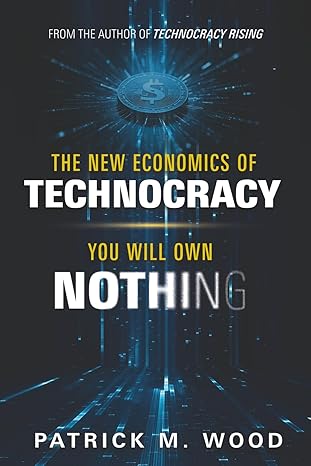
"In 2016, the World Economic Forum (WEF) declared that by 2030, "you'll own nothing and you'll be happy." The backlash was swift. The WEF scrambled to reframe the statement as merely one possible "scenario." But the damage was done—not because the statement was shocking, but because it was honest. It described, in plain language, the operational endgame of a system that has been under construction for nearly a century.
This book documents the endgame and how it is being brought about. It is not future tense. It is happening now! The new economic system of Technocracy flips everything on its head: the end of debt, the end of private property, the end of personal sovereignty and privacy, and the end of our political system.
This is a book about the most consequential economic transformation in modern history—one that has been in preparation since 1934 and is now entering its operational phase. The march toward Technocracy is neither Democrat nor Republican, liberal nor conservative. Since 1973, every administration has advanced it, and followers of every ideology have served as its useful idiots.
You will own nothing. Not because they will steal it from you. Because they are building a system that doesn't provide for ownership at any level."

"The dark horse of the New World Order was never Communism, Socialism or Fascism: It has always been Technocracy! Started in the 1930s, re-introduced by the Trilateral Commission in 1973 as the "New International Economic Order," Technocrats have staged a sweeping coup d'état in plain sight in Washington, DC. during the Trump presidency.
The Dark Enlightenment wants to turn us into a monarchy. Tokenization is flipping us into an asset-based economic system where you "will own nothing". AI is shoving us into a digital Gulag. Like it or not, you must face this beast, either to destroy it or learn to live with it.
Patrick Wood has been warning you for 15 years. It's time to pay attention."
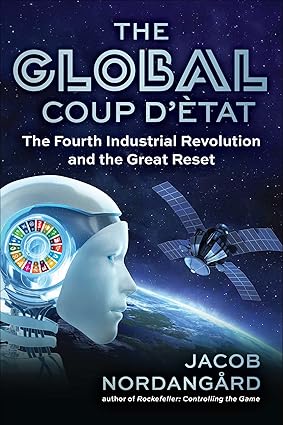
"We are in the midst of a devastating takeover of our world. The Global Coup d'État shows how, why, and what we can do to stop it. The year 2020 will go down in history as the year when the global coup d'état was initiated. The Great Reset requires mankind to be fully integrated and merged with a worldwide technological system, through the application of the technologies of the Fourth Industrial Revolution—all for our own safety, security, and well-being.
In The Global Coup d'État, author and researcher Jacob Nordangård shares the history, describes the process, reveals the methods, and identifies the agents of this worldwide takeover so that we can take action before it is too late."
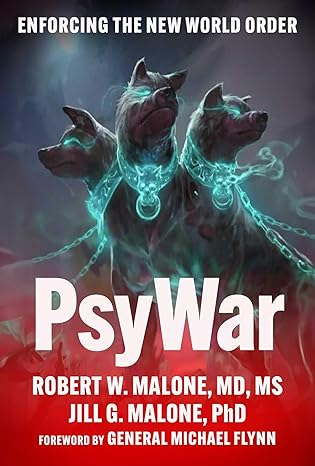
"This book exposes the history and tactics of modern psychological warfare on the American people and offers a way forward for citizens to resist totalitarian control.
PsyWar is when a government coordinates and directs deployment of propaganda, censorship, and psychological operations (psyops) tools in campaigns designed to manipulate public opinion. The authors address critical topics including:
- Propaganda and Behavioral Control;
- Psychological Bioterrorism;
- Deep State Censorship;
- Surveillance Capitalism;
- Administrative State Objectives;
- Fifth-Generation Warfare;
- PsyWar Tactics;
- Techno-Totalitarianism;
- The New World Order and Global Control.
Free speech is the most pragmatic tool we have for ascertaining truth. Only by examining all sides of an issue can the truth be chiseled out like a statue out of marble. We must defend all speech—whether untrue, hateful, or intolerable, as that is the only way to protect our right to understand the world. As soon as free speech is restricted, that restriction will be used to sway public opinion."

"The transnationally coordinated response to "Covid-19" witnessed numerous developments reminiscent of the prewar years of the Third Reich, including the suspension of constitutional rights and freedoms, the rollout of draconian legislation, an attempted revolution from above (the "Great Reset"), the censorship of dissent, health surveillance, euthanasia, eugenics, the corruption of science by politics, and the hijacking of conscience. The list goes on.
Totalitarianism does not spring, fully formed, into existence. In the case of Nazi Germany, the descent into barbarism took place gradually, over many years. Today, the warning signs from history are flashing red. Unless the global technocratic coup being attempted is put down, we can expect centralization of power in a New World Order, the return of slavery, privatization of the global commons, the transformation of society into a biodigital camp, the end of the rule of law, the normalization of eugenics, and systematic mass murder of dissidents."
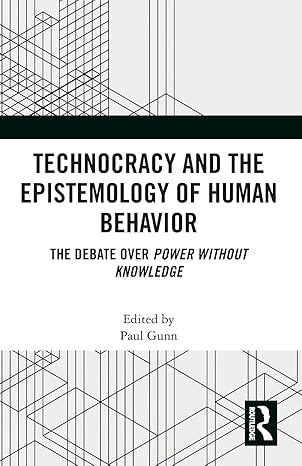
"In Power Without Knowledge: A Critique of Technocracy (2019), Jeffrey Friedman presented a sweeping reinterpretation of modern politics and government as technocratic, even in many of its democratic dimensions. Building on a new definition of technocracy as governance aimed at solving social and economic problems, Friedman showed that the epistemic demands that such governance places on political elites and ordinary people alike may be overwhelming if technocrats fail to attend to the ideational heterogeneity of the human beings whose control is the object of technocratic power.
In Technocracy and the Epistemology of Human Behavior, thirteen political theorists, including Friedman himself, debate the implications of Power Without Knowledge for social science, modern governance, the politics of expertise, post-structuralism, anarchism, and democratic theory; and Friedman responds to his critics with an expansive defense of his vision of contemporary politics and his political epistemology of ideationally diverse human beings."
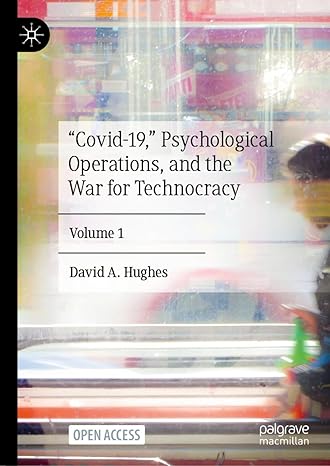
"The multiple converging strands of evidence laid out by Hughes lead readers time and again to the same place: a precipice of global technocratic totalitarianism and biodigital enslavement, being pushed by the wealthiest 0.001 percent upon the rest of humanity. Hughes' book lights the paths laid here by decades of mind control, both psychological and technobiological. It is impossible to overstate the contribution that this volume makes to the literatures on psychology and governance, and humanity's trajectory into World War III. While sober and sobering, if Hughes' lucid and unflinching approach to academic scholarship catches on, humanity might just stand a chance, armed with insight and understanding." ~ Valerie Kyrie, Ph.D.
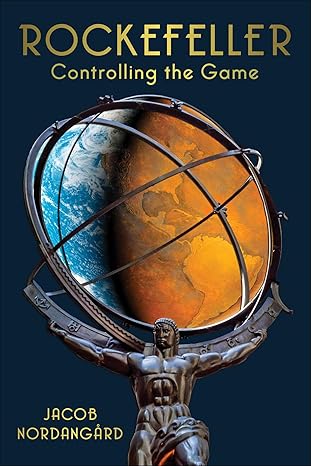
"The Rockefeller family is one of the richest in the world. Yet, why would the family that made the world dependent on oil fund environmental and climate research since the 1950s, help shape climate policy measures since the 1980s, and supported climate activism since the 1990s?
This book is the thrilling and paradoxical story of one of the world's most influential global players. Through its top position in American business, close contacts with the White House, and with their immense financial power as one of the world's leading private research funders, the Rockefellers have been able to anchor the climate issue both scientifically and politically. Yet what is the reasoning behind doing so?
The Rockefeller family's utopian dream of a perfect world will have serious consequences for the survival of the human species and life as we know it. The Rockefeller Foundation's stated mission to "promote the well-being of humanity throughout the world" has a dark flipside, as, Nordangard will prove, the Rockefeller family's long-standing battle against climate change contains elements of sophisticated propaganda techniques, futurism, and New Age philosophy, aiming at a complete transformation of the whole earth system, including economy, ecology, culture, and even humanity itself."
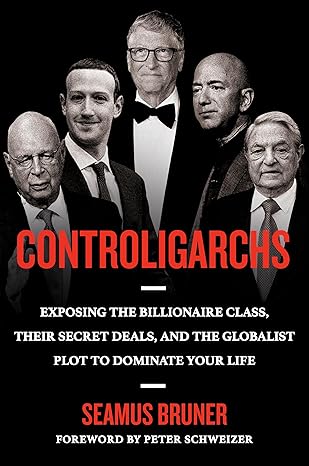
"Imagine a world in which you own nothing and rent everything. Most of the protein in your diet comes from bugs. You are not allowed to have more than one child, and your financial and medical data are instantly transferred to a centralized government database via a subdermal microchip.
Controligarchs warns that this will be our existence if the supranational elites of the World Economic Forum get their way.
In this book, investigative journalist Seamus Bruner—who led the teams whose findings sparked multiple FBI investigations and congressional probes into the Clintons and the Bidens—exposes the billionaires who control the levers of power that dominate every aspect of your life.
Inside this pathbreaking book, you will discover:
- Bill Gates' $11.7 billion food takeover scheme ... and the real reason he's snapping up America's farmland;
- Mark Zuckerberg's $36 billion plot to reengineer society and force you into tech addiction;
- Jeff Bezos' taxpayer-funded electric vehicle ambitions, climate hypocrisy, and $1.2 billion plan to spy on you by overseeing your "SMART" home;
- The Soros family's project to use its $25 billion empire to influence elections and society for the next 50 years;
- How World Economic Forum (WEF) founder Klaus Schwab built an exclusive club in Davos where the top 25 WEF members—now worth more than $10 trillion—have more economic power than most world governments, and how these global oligarchs are seizing control over our future.
Based on a mountain of financial filings, insider documents, and corporate records, Controligarchs rips back the curtain on never-before-published revelations about the life-altering schemes that globalist elites have in store for you. This book is a must-read for anyone who values American independence and personal freedom."
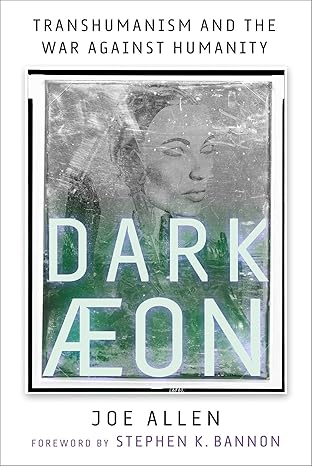
"Like a thief in the night, artificial intelligence has inserted itself into our lives. It makes important decisions for us every day. Often, we barely notice. As Joe Allen writes in this groundbreaking book, "Transhumanism is the great merger of humankind with the Machine. At this stage in history, it consists of billions using smartphones. Going forward, we'll be hardwiring our brains to artificial intelligence systems."
With an academic background in both science and theology, Allen confronts the paradox of what he calls "good people constructing a digital abomination." Dark Aeon is nothing less than a cri de coeur ["a cry from the heart"] for humanity itself. He takes us on a roller coaster ride through history and the emergence of Scientism, and from government-mandated mRNA vaccines to the weird visions of cyborg billionaires like Elon Musk.
From Silicon Valley to China, these globalists' visions of humanity's future, exposed and described in Dark Aeon, are dire and terrifying. But Joe Allen argues that humanity's salvation is within our grasp. Only if we refuse to avert our eyes from the impending twilight before us."

"This book explores how the pandemic has transformed our use and perception of digital technologies in various settings. It also examines the right to resist or reject these technologies and the politics of refusal in different contexts and scenarios.
The book offers a timely and original analysis of the new realities and challenges of digital technologies, paving the way for a post-COVID-19 future."
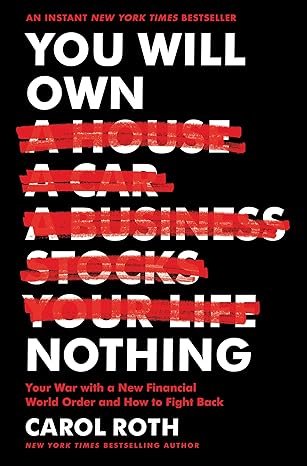
"The bestselling author and entrepreneur investigates what would happen if a new financial world order took hold, one in which global elites own everything and you own nothing—and yet you are somehow happy.
When Carol Roth first heard that one of the World Economic Forum's predictions for 2030 was "You will own nothing, and be happy," she thought it was an outlandish fantasy. Then, she researched it. What she found was that a number of businesses, governments, and global elites share a vision of a future that sounds utopian: Everyone will have everything they need, and no one will own anything.
From declines in home and vehicle ownership to global inflation and government spending, many of the trends of modern life reveal that a new world that is emerging—one in which Western citizens, by choice or by circumstance, increasingly do not own possessions or accumulate wealth. It's the perfect economic environment for the rich and powerful to solidify their positions and prevent anyone else from getting ahead.
In this book, Roth reveals how the agendas of Wall Street, world governments, international organizations, socialist activists, and multinational corporations like Blackrock all work together to reduce the power of the dollar and prevent millions of Americans from taking control of their wealth. She shows why owning fewer assets makes you poorer and less free. This book is an essential guide to protecting your hard-earned wealth for the coming generations."
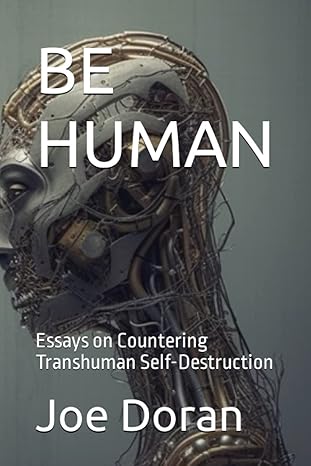
"This work completes a trilogy which began with Leaving Humanity and continued with De-Human, much of it compiled from Joe Doran's writing in The Trends Journal magazine.
Taken as a whole, these books give both a broad analysis and a detailed survey of modern Technocracy, including where it's likely to go from here, unless humans take a stand for their rights, and for an understanding of the world and themselves that rejects the false "progress" of scientism and transhumanism."
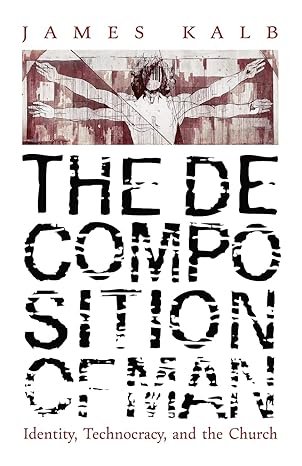
"Identity politics and novel identities are everywhere today. This takes on these issues in a new and illuminating way. The social crisis we are facing involves weakening traditional identities—man, woman, husband, wife, Catholic, American—and asserting constructed ones like "Latinx" and "nonbinary." This is liberating, we are told. In reality, however, as the familial, religious, and communal arrangements by which people have hitherto lived unravel, they are taken over by commercial, bureaucratic, and state interests. And as human bonds weaken, confusions multiply, families fall apart, needs go unmet, and people forget who they are.
This book traces the present crisis back to such social changes as industrialization, globalization, and the technological ways of thinking that accompany them. An adequate response will require a renewed emphasis on tradition and natural law, as well as a turn toward local community and toward religion—in particular, Catholicism. That will certainly be an arduous labor, but current trends are clearly unsustainable. Kalb directs this indispensable book to all who wish to understand what lies behind developments that often seem so strange, and how to deal with the new and often threatening world now coming into being."
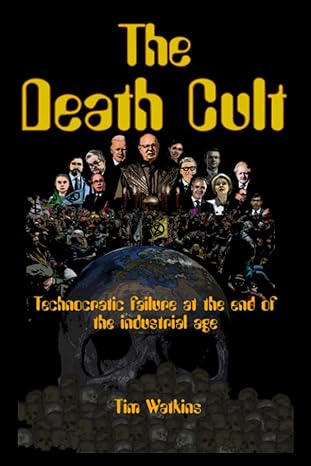
"Watkins demonstrates that the technocratic vision of a digital future — variously known as "the fourth industrial revolution," "the green new deal," and "the great reset," — lacks any grounding in reality and has been proven to be impossible given the material resources available to us on planet Earth.
In this book, Tim Watkins explains the origins of the ruling technocracy, and how it became a "class for itself" — no longer interested in the little people whose lives it desires to take ever more control over, and, indeed, even hostile to planet Earth itself.
Watkins outlines the graft and corruption at the heart of technocratic rule. Even as, time and again, our self-identifying rulers demonstrate their incompetence, we are left with no mechanisms by which we can remove them. Not least because our own protest has been co-opted by the technocracy via so-called "stakeholder capitalism."
Technocracy is setting itself up to fail, but in the process it will inflict untold hardship on those it deigns to rule."
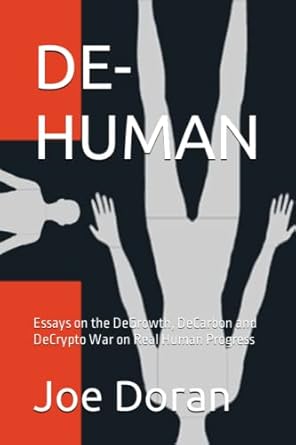
"Elites speak the language of human progress. But that is a smokescreen to bamboozle the masses that their radical impositions will create more abundance, more "clean energy," more "food security," more "equity and fairness", more geopolitical harmony and peace, etc.
In fact, corruptly wealthy and manipulative technocrats have no real interest in making humankind more prosperous or more free.
Quite the opposite. Scratch the surface, and their proscriptions are all concerned with the same objective: suppressing, dispensing with, and separating themselves from the useless masses.
Elites don't require the bulk of humanity. But they especially don't need the ones most prominently and effectively opposing and exposing their agendas. The purpose of this work is to stir as many people as possible to examine and question the actual pursuits, policy prescriptions of technocratic elites."
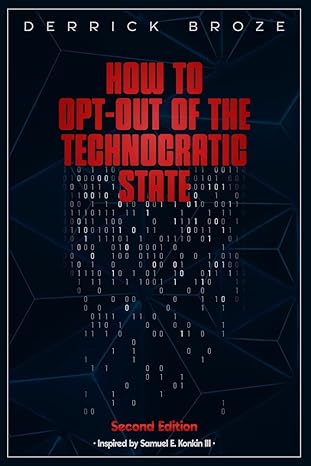
"As humanity enters the third decade of the 21st century, we find ourselves at the precipice of a Technocratic Age where Artificial Intelligence, SMART Technology, and the Internet of Things are becoming a part of everyday life. This technology provides benefits, but comes at a cost-corporations, governments, law enforcement, and hackers are all capable of peering into our lives at any moment. Corporations and governments are even learning to use technology in ways that allow them to be the engineers of society. The concept of social credit is also becoming increasingly popular, and the likelihood that citizens will face negative consequences for choosing to speak about controversial topics or criticizing authorities is only going to increase.
This book examines the current push toward "SMART Grid" technology, and explores the concept of Technocracy. Do you want to understand the philosophy that guides our digital world? Are you looking for practical solutions to maintain privacy and liberty?
In five new chapters, Broze documents the advance of the Technocratic State during "COVID-1984," and shares tips, tactics, and strategies for thriving in the face of the coming digital identity schemes, Central Bank Digital Currencies, lockdowns, and travel restrictions.
It is time to learn how to opt-out of the Technocratic State."
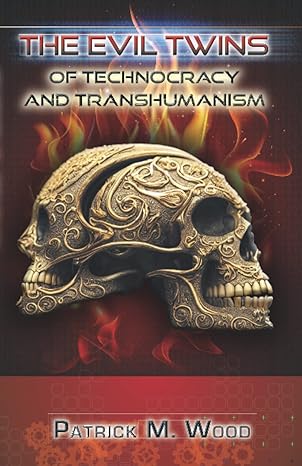
"This is the everyman's introduction to Technocracy and Transhumanism that builds on my previous books on Technocracy. Both are primary to the World Economic Forum's Great Reset, in partnership with the United Nations, to replace Capitalism with an alternative economic system called Sustainable Development, aka Technocracy. Further, humans themselves are targeted by Transhumanists to change the human condition into Humans 2.0 via genetic engineering. Thus, Technocracy transforms the structure and economic system of the world, while Transhumanism transforms the people who live there.
Technocracy wants to rule the earth in a panopticon of scientific dictatorship. Transhumanists want to live forever and become omniscient. Both are mechanistic systems that see nature as something to be studied, manipulated and conquered. Both see themselves as the new intelligent designers of the world, including humans. Both seek to craft a future for planet earth that nobody asked for, voted for or wanted.
It is my hope that this book will not depress you but rather encourage you to take your proper place in the world by doing your part to put a stop to the Evil Twins of Technocracy and Transhumanism."
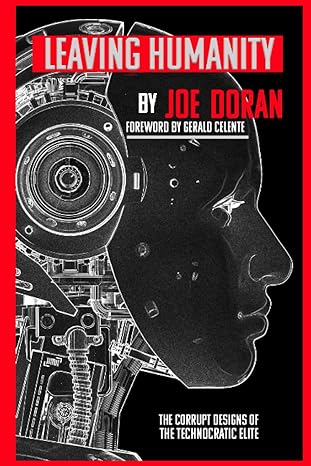
"There's nothing sci-fi or futuristic about what technocratic elites are designing right now for the world, as this book clearly documents.
Bio Pharma, with CRISPR-fueled genetic alterations to humans, animals and other natural life, is exploding. Genetic legislation—a term coined by Doran—took a huge step toward reality with COVID gene therapies. On a cry of "emergency," Doran is warning that laws will soon be encoded in our genes, where they can't be defied.
Polygenic risk tests, meanwhile, are already ushering in a new techno-eugenics bent on producing "superior" offspring. GMO plants and insects are being released into the wild, and hybrids of humans and animals are being produced with little more than lip service concerning ethical standards.
But that's not all. The Technocracy is racing to spawn self-directed "conscious" AI and robotics that will outstrip man in intelligence and physical abilities. It's been called the Singularity, and as Doran chronicles, it's just around the corner.
Leaving Humanity is a clarion call to hold technocratic elites to account, before they fundamentally alter the world and natural humankind forever."

For far too long, American history has been left in the unreliable hands of those that author Donald Jeffries refers to as the court historians. Here he fights back by scrutinizing the accepted history on the assassination on everything from the American War of Independence to the establishment reputation of Thomas Jefferson and the other Founding Fathers, the Civil War, the Lincoln assassination, both World Wars, US government experimentation on prisoners, mental patients, innocent children and whole populated areas, the Lindbergh baby kidnapping and much, much more.
Jeffries spares no one and nothing in this explosive book. The atrocities of Union troops during the Civil War, and Allied troops during World War II, are documented in great detail. The Nuremberg Trials are presented as the antithesis of justice. In the follow-up to his previous, bestselling book Hidden History: An Exposé of Modern Crimes, Conspiracies, and Cover-Ups in American Politics, Jeffries demonstrates that crimes, corruption, and conspiracies didn't start with the assassination of President John F. Kennedy.
History should be much more than cardboard villains and impossibly unrealistic heroes. Thanks to the efforts of the court historians, most Americans are historically illiterate. Crimes and Cover-ups in American Politics: 1776-1963 is a bold attempt at setting the record straight."

"When the World Health Organisation declared the pandemic they signalled to governments around the world that they must take action to protect their populations from the ravages of a pandemic disease. Did they also alert a global network of public-private partnerships that their opportunity had arrived?
Many warned that the measures taken to protect the public would add further unnecessary suffering. They stated that the policy response to the COVID 19 pandemic was contrary to the scientific evidence and prevailing epidemiological wisdom. Raising concerns about devastation caused by lockdowns and other mitigation measures, they maintained that the cure was worse than the disease.
Convinced by the politicians and the media that the scale of the threat necessitated unprecedented restrictions, the vast majority considered these sceptics to be fools. But what if the sceptics were right?
Upon rigorous examination of the evidence, Pseudopandemic explores the unthinkable and delivers a damning indictment of global corruption.
It charges the reader to confront a stomach churning reality. Once eyes are opened they cannot look away."
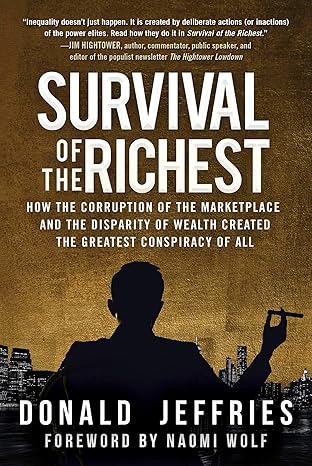
"Survival of the Richest scrutinizes how the collective wealth of America has been channeled from the poor and middle class into the hands of a few elites.
American industry has been gutted, with wages and benefits stagnant or reduced, thanks to a disastrous trade deals, outsourcing, and the crippling of unions. The Occupy Wall Street movement, and the presidential campaigns of both Bernie Sanders and Donald Trump, reveals how more and more people who are struggling understand that the system is rigged against them.
Donald Jeffries argues that this record economic inequality is more than an unintended consequence of globalism. In Survival of the Richest, he shows how the consolidation of wealth may well prove to be the greatest conspiracy of all."

"As humanity enters the second decade of the 21st century, we find ourselves at the precipice of a Technocratic Age where Artificial Intelligence (AI), SMART Technology, and the Internet of Things are becoming a part of everyday life. This technology provides benefits but comes at a cost—corporations, governments, law enforcement, and hackers are all capable of peering into our lives at any moment. Corporations and governments are even learning to use technology in a way that allows them to be the "social engineers" of society. The concept of social credit is also becoming increasingly popular, and the likelihood that citizens will face negative consequences for choosing to speak about controversial topics or criticizing authorities is only going to increase.
It is time to learn how to opt-out of the Technocratic State."
"Technocrats claim to know how to solve the social and economic problems of complex modern societies. Friedman argues that technocratic experts themselves drastically oversimplify technocratic realities. Economists, for example, theorize that people respond rationally to the incentives they face. Power without Knowledge is a pathbreaking work that upends traditional assumptions about technocracy and politics, forcing us to rethink our assumptions about the legitimacy of modern governance."
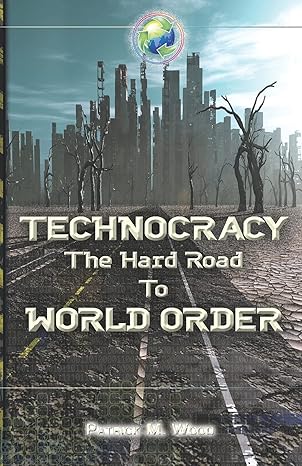
"In 1974, Trilateral Commission member and academic Richard Gardner wrote an article "The Hard Road to World Order" for Foreign Affairs magazine, predicting the future of the Commission's self-proclaimed New International Economic Order. Gardner spoke of an "end-run around national sovereignty", a "booming, buzzing confusion" and building it from the "bottom up" rather than attempting an "old-fashioned frontal assault."
After almost 45 years, it is time to examine the record. In Technocracy: The Hard Road to World Order, Wood traces the steps and developments that led to the United Nations' establishment of Sustainable Development as an outgrowth of historic Technocracy from the 1930s. UN programs such as 2030 Agenda, New Urban Agenda and the Paris Climate Agreement are all working together to displace Capitalism and Free Enterprise as the world's principal economic system.
As a resource-based economic system, Sustainable Development intends to take control of all resources, all production and all consumption on planet earth, leaving all of its inhabitants to be micro-managed by a Scientific Dictatorship. Topics covered include the devolution of federal governments combined with the rise of global SMART Cities. Tools are examined, like ubiquitous surveillance, collaborative governance, Public-Private Partnerships, Reflexive Law, Fintech, including crypto currencies and the drive toward a cashless society.
It's time for citizens to stand up to reject them. As always, Wood closes with the nature of effective resistance and the tools that can help to achieve success."
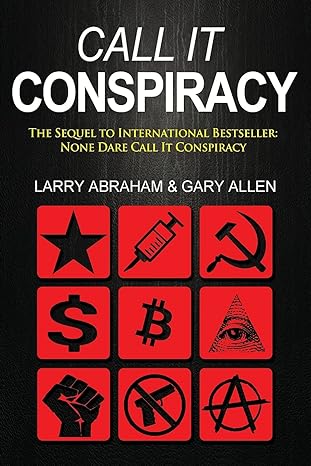
"In this edition, Larry Abraham has revised None Dare Call It Conspiracy, and brought it up to date. The events of the last fifteen years have served Larry's thesis quite well. As far as Larry is concerned, the history of 1970-85 has been a kind of giant grab-bag of goodies that reinforce his original thesis. The arguments for the existence of a conspiracy are stronger today than they have ever been, especially when we lay them alongside of what was said and written before. Therefore, chapters one through seven are going to remain the same as in the original book, None Dare Call It Conspiracy. The bracketed updates are new, and so are chapters eight through thirteen, plus the various appendices."
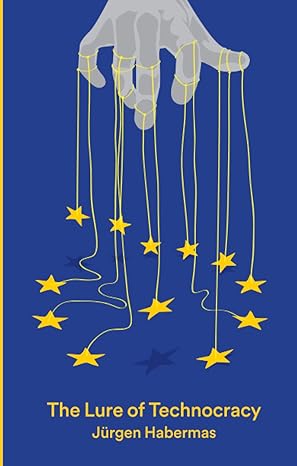
"Over the past 25 years, Jurgen Habermas has presented what is arguably the most coherent and wide-ranging defence of the project of European unification and of parallel developments towards a politically integrated world society. In developing his key concepts of the transnationalisation of democracy and the constitutionalisation of international law, Habermas offers the main players in the struggles over the fate of the European Union – the politicians, the political parties and the publics of the member states – a way out of the current economic and political crisis, should they choose to follow it. In the title essay Habermas addresses the challenges and threats posed by the current banking and public debt crisis in the Eurozone for European unification. He is harshly critical of the incrementalist, technocratic policies advocated by the German government in particular, which are being imposed at the expense of the populations of the economically weaker, crisis-stricken countries and are undermining solidarity between the member states. He argues that only if the technocratic approach is replaced by a deeper democratization of the European institutions can the European Union fulfil its promise as a model for how rampant market capitalism can once again be brought under political control at the supranational level."
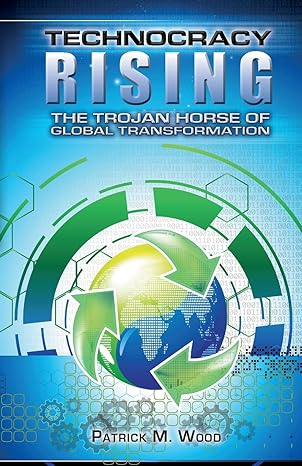
"The dark horse of the New World Order is not Communism, Socialism or Fascism. It is Technocracy.
With meticulous detail and an abundance of original research, this book connects the dots of modern globalization in a way that has never been seen before so that the reader can clearly understand the globalization plan, its perpetrators and its intended endgame.
Wood contends that the only logical outcome of Technocracy is Scientific Dictatorship, as already seen in dystopian literature such as Brave New World by Aldous Huxley (1932) and Nineteen Eighty-Four by George Orwell (1948), both of whom looked straight into the face of Technocracy when it was still in its infancy."
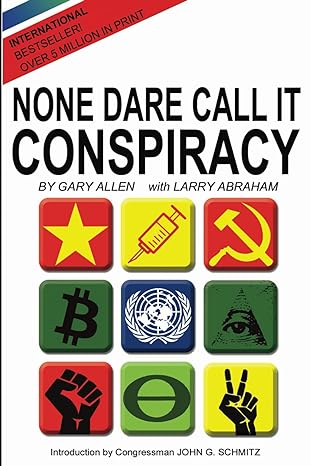
"The story you are about to read is true. The names have not been changed to protect the guilty. After reading this book, you will never look at national and world events in the same way again. Eventually, it will be necessary for the people and organizations named in this book to try to blunt its effect by attacking it or the author. They have a tremendous vested interest in keeping you from discovering what they are doing. And they have the big guns of the mass media at their disposal to fire the barrages at None Dare Call It Conspiracy. By sheer volume, the "experts" will try to ridicule you out of investigating for yourself as to whether or not the information in this book is true. They will ignore the fact that the author is about to conjecture. They will find a typographical error or argue some point that is open to debate. If necessary, they will lie in order to protect themselves by smearing this book."

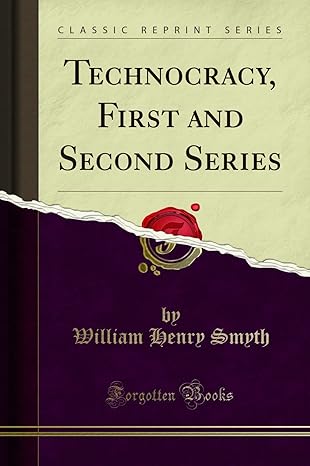
"Harold Loeb, an expatriate in Paris in the 1920s, was one of the more accomplished and interesting of the technocrats. In this book he expounds on the merits of creating a utopian society through technocracy, predicting the future of art, education, religion, and government under the leadership of technical professionals."


How can you spread the message that They Lied?
Stay up to date with our Newsletter
Click here to read it,
or subscribe below ...
or subscribe below ...
Click here to STOP the Globalist Agenda
Click here to support our work.
Click here to email us at contact@theylied.ca